Which entrance doors to choose for a flat in an apartment block?

Entrance doors to a flat in an apartment block, also called apartment entrance doors, separate the flat from the shared staircase and are responsible above all for security, sound insulation and thermal comfort. The choice depends on four issues: burglar resistance class (RC), sound insulation, thermal insulation and compliance with building regulations.
In Poland, the law requires such doors to have a clear frame opening of at least 0.9 m wide and 2.0 m high, a threshold no higher than 2 cm, and to open into the flat. Good entrance doors combine effective burglar protection — for a flat, class RC2 is usually sufficient — with sound insulation of at least 30 dB.
Apartment entrance doors: key parameters
When choosing entrance doors for a flat in an apartment block, three parameters count: protection against noise, thermal insulation and burglar resistance. Below is a summary of what to look out for.
- Protection against noise. Living in an apartment block often means greater exposure to noise from the staircase. Soundproof apartment entrance doors, such as the Hyperion EI30 RC2 model, ensure peace and quiet thanks to sound insulation of 38 dB.
- Thermal insulation. Doors should not only protect against noise, but also keep the heat in and limit draughts. Models with a low heat transfer coefficient, such as Forteca RC2, offer good thermal insulation.
- Security. Burglar-resistant doors are essential to feel safe in your own home. Erkado designs doors in accordance with RC burglar resistance classes, offering products from basic RC1 protection to advanced RC3.
In addition to these parameters, the choice of frame, the quality of the lock and hinges and the correct leaf size are also important. These issues are regulated by building law, which we discuss below.
Dimensions, threshold and opening direction — what the law requires
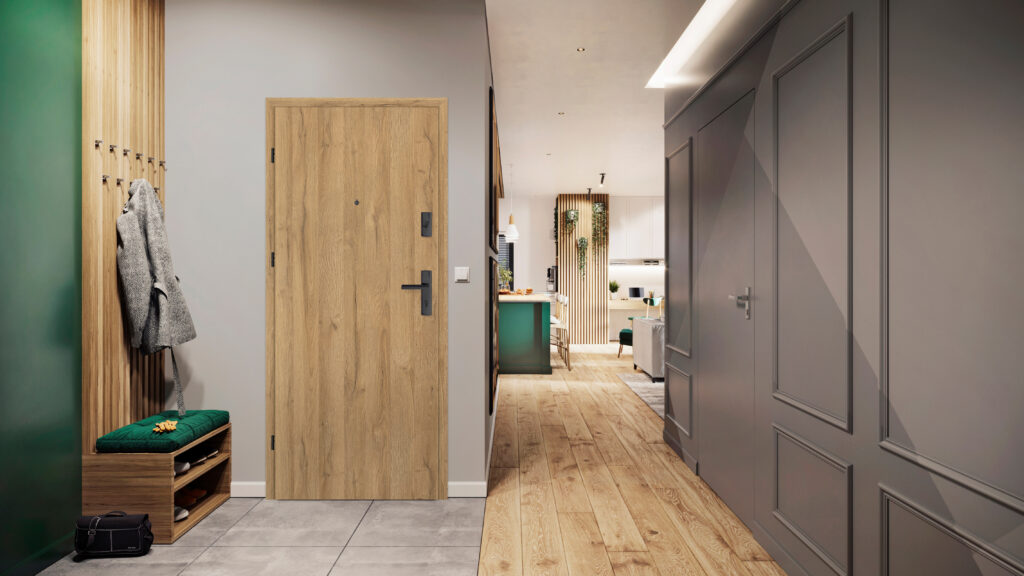
In Poland, apartment entrance doors must meet specific building requirements: a clear frame opening of at least 0.9 m wide and 2.0 m high, with a threshold no higher than 2 cm. These requirements are set out in the Regulation of the Minister of Infrastructure on the technical conditions to be met by buildings and their location (Journal of Laws 2022, item 1225, § 62). In practice, many investors choose a wider leaf, e.g. 100 cm, which makes it easier to carry in furniture and household appliances.
The second often overlooked issue is the opening direction. In multi-family buildings, apartment entrance doors should open into the flat — this is a matter of evacuation safety and ensuring that the open leaf does not block the shared corridor or access to neighbouring flats. Replacing doors in an apartment block may also require the consent of the housing cooperative or community if they are treated as a common part of the building, so it is worth checking the building rules before buying.
What are entrance doors made of?
The construction of apartment doors determines their durability, security and acoustic and thermal insulation. In the advanced construction of these doors, the frame is made of MDF covered on both sides with HDF boards — this combination of materials guarantees high stability and resistance to deformation. The core is a specialist solid board that provides good sound and thermal insulation. The construction is further reinforced with a massive steel channel, which increases the door’s resistance to mechanical damage and break-in attempts.
Doors designed in this way provide solid protection for any flat, combining modern technologies with an attractive finish. An example is the Herse Max Set 29 model, which imitates wood and suits a variety of interiors. Entrance doors can also have a fire protection function — resistance to fire and smoke is important in some projects. In such cases, Leda EI30 fire doors, made using Halspan technology, which combine fire, smoke and acoustic protection, are a good choice.
Read also: Steel exterior doors: what are their characteristics and which model to choose?
The look and finish of entrance doors
Entrance doors are the calling card of a flat, so in addition to technical parameters, their appearance also counts. Manufacturers offer a wide range of colours and finishes — from wood-effect veneers, through smooth surfaces in shades of anthracite, grey and white, to classic wooden doors. Modern entrance doors increasingly echo the design of the interior doors in the flat, creating a coherent arrangement. It is worth matching the finish to the style of the interior and your own preferences, remembering that attractive design should not come at the expense of workmanship, insulation or burglar resistance class.
High sound insulation of apartment entrance doors
Good sound insulation of doors to a flat in an apartment block starts at 30 dB, and the best models reach around 38 dB — every point above the minimum is a real benefit. Living in an apartment block, we are exposed to far more sounds than in a detached house. Footsteps, children running, loud greetings and goodbyes of guests, the sound of a bicycle, scooter or pram being dragged up the stairs — these are just some of the sources of noise from the staircase. If it is repeated every day, it quickly becomes a nuisance.
Soundproof apartment entrance doors reduce this problem in both directions: they muffle noise from outside and at the same time ensure discretion by preventing conversations from reaching the staircase. Good sound insulation is particularly important for people working from home, having frequent conversations or with small children whose sleep is easily disturbed by outside noise. When choosing a model, it is worth matching the level of insulation to your own needs and lifestyle.
Thermal insulation of apartment entrance doors
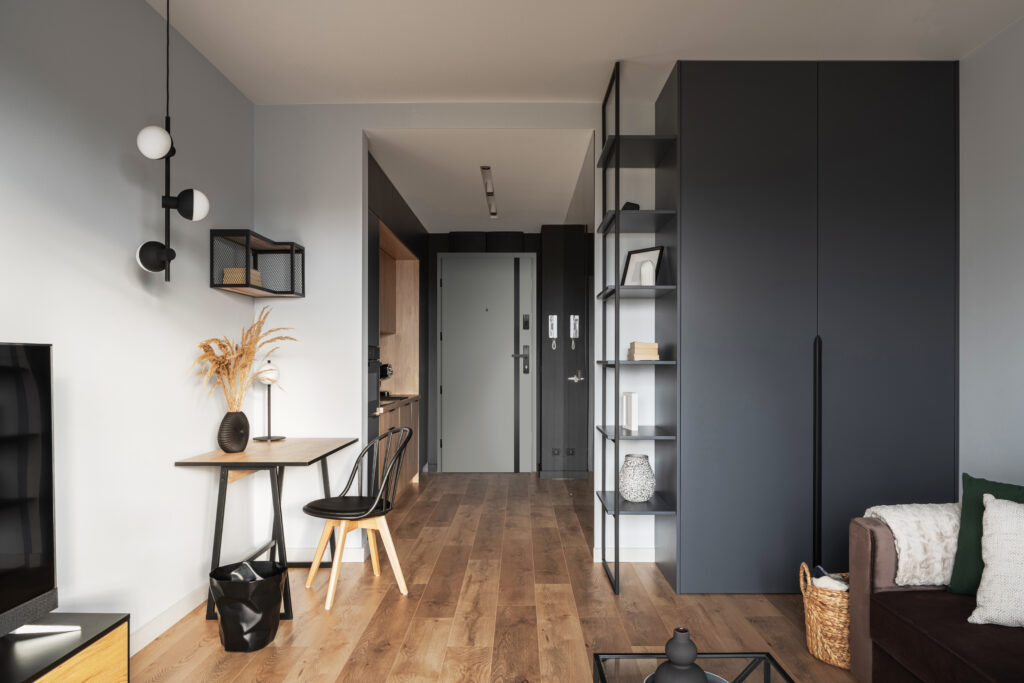
Apartment entrance doors should protect the flat against cold and draughts from the staircase, even though they are not exposed to weather conditions like exterior doors of a house. Thermal insulation is determined by the heat transfer coefficient U — the lower its value, the “warmer” the leaf. Polish technical regulations require that, for exterior doors separating a heated interior, the U-value must not exceed 1.3 W/(m²·K).
It is worth remembering that effective thermal insulation depends not only on the leaf itself, but to a large extent on the seals and correct “warm” installation, which eliminates thermal bridges around the frame.
Which burglar-resistant doors to choose for a flat?
For a flat in an apartment block, it is best to choose burglar-resistant doors — a reinforced construction provides a sense of security and protects valuables stored in the flat. Burglar resistance is classified by the EN 1627 standard, which distinguishes six classes: from RC1 (basic protection) to RC6 (the highest level). For a typical flat, class RC2 is sufficient in practice, while RC3 is a solution for people who expect increased security.
Erkado offers its own series of burglar-resistant doors: the solidly built Forteca RC2 model and the tasteful Forteca RC3. Both models also provide very good sound insulation of 38 dB. The real resistance of a door is also determined by construction details: anti-lift bolts on the hinge side, a multi-point lock and a matching steel frame.

Apartment entrance doors vs exterior doors — what is the difference?
Exterior doors to a flat in an apartment block (apartment entrance doors) differ from classic exterior (front) doors of a detached house primarily in that they are not exposed to rain, sun and frost. That is why in a flat the emphasis is mainly on sound insulation and burglar resistance, and to a lesser extent on protection against weather conditions. Exterior doors of a house, on the other hand, must meet stricter requirements for thermal insulation and tightness, as they separate the interior directly from the outside. In terms of security, both types use the same scale of RC classes.
Offer for developers and investors
Erkado offers developers and investors special terms of cooperation for bulk orders of entrance doors for new housing estates. Products designed with security, functionality and aesthetics in mind work well in modern projects. Cooperation includes comprehensive technical advice and the possibility of adapting doors to specific project requirements. Developers can count on attractive discounts and on-time deliveries, which speeds up construction work and increases the attractiveness of the flats on offer. For details, please contact the Erkado team.
FAQ – Frequently asked questions
Summary
When choosing apartment entrance doors, it is worth paying attention to all the parameters discussed — burglar resistance class, sound and thermal insulation and compliance with building regulations — to choose the model that best meets your needs. Detailed information is provided by Erkado advisers, who will help you choose the right doors.
Sources
The sources below confirm the most important technical and legal data cited in the article — the required dimensions, threshold and opening direction of the door and the burglar resistance classification. They form the basis of the regulations that apply in Poland when choosing and replacing apartment entrance doors.
Standard EN 1627 — burglar resistance classes (RC1–RC6) for doors and windows.
Regulation of the Polish Minister of Infrastructure of 12 April 2002 on the technical conditions to be met by buildings and their location (Journal of Laws 2022, item 1225), § 62 — door dimensions, threshold height, opening direction, heat transfer coefficient: https://arslege.pl/warunki-techniczne-wejsc/k218/a23209/